
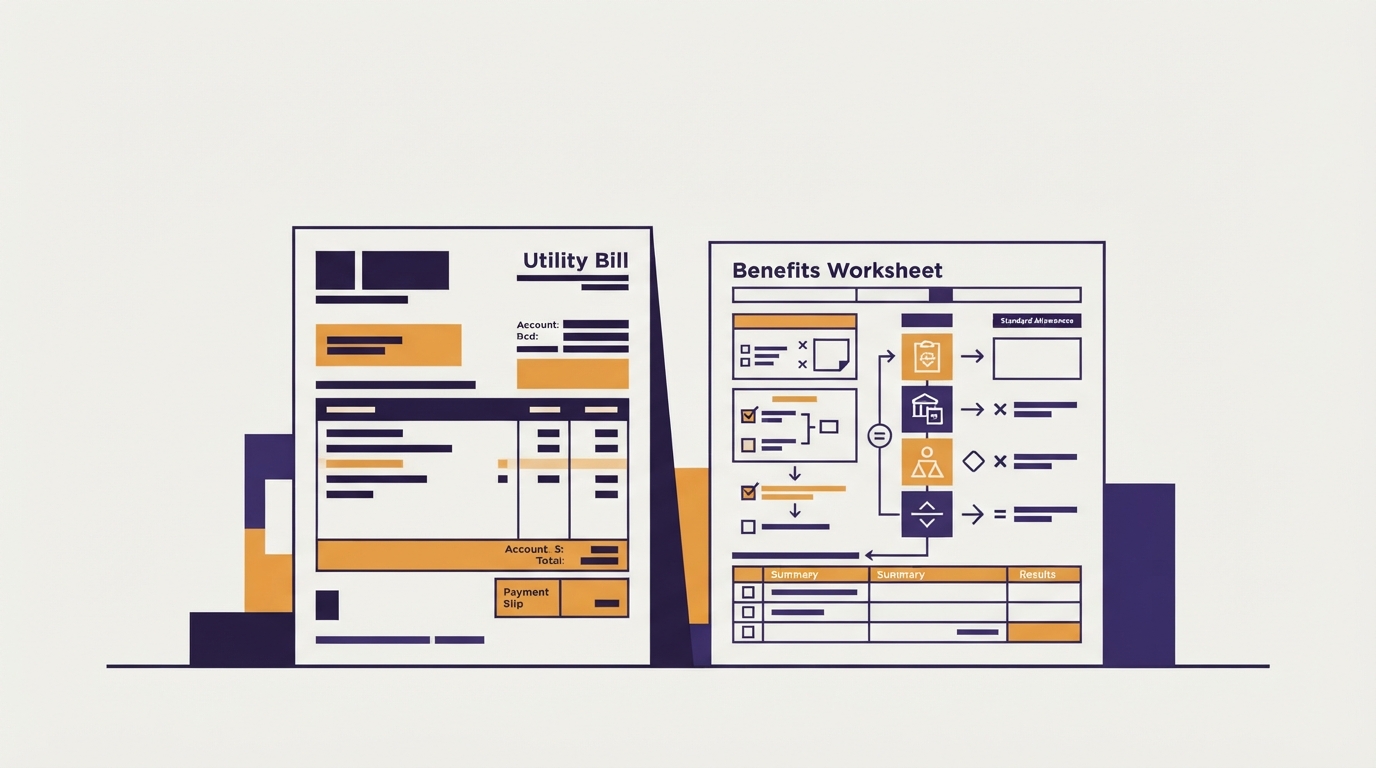
What a standard utility allowance (SUA) is and why states use it
When a caseworker calculates your benefit amount for SNAP (and in some cases other programs that use similar deduction rules), one of the factors that lowers your countable income is your shelter and utility cost. Utility costs are things like heating, cooling, electricity, water, sewer, trash, and phone service. Instead of asking every household to submit every utility bill, tally the amounts, and average them across a year of seasonal swings, most states offer a standard utility allowance: a flat dollar figure that stands in for your actual utility expenses.
The SUA exists because actual utility costs are messy to document and messy to verify. Bills spike in winter and summer, arrive under a roommate’s name, get bundled into rent, or simply go missing when someone moves frequently. Rather than have every caseworker adjudicate a stack of uneven bills, states set one or more standard amounts—often a full SUA for households with heating or cooling costs, and a smaller amount for households with fewer utility types—and let eligible households use that number instead of itemizing.
Using the standard amount doesn’t change what the deduction is for. It changes how it’s calculated. You still get credited for utility costs in your budget; you just don’t have to prove the exact dollar figure you paid last month.
When you qualify to claim the SUA instead of actual costs
Eligibility to use the SUA generally depends on whether your household is responsible for paying a qualifying utility expense separately from rent, not on whether you can produce a bill. If you pay for heating or cooling directly—even a small monthly amount, even if a roommate’s name is on the account—you typically qualify for the full standard allowance. If you don’t pay for heat or air conditioning but do pay for something like electricity, water, or a phone, you may qualify for a lower, limited standard allowance instead.
Households that pay nothing toward utilities—because everything is included in rent, or a landlord covers it, or another household member pays all of it and doesn’t share costs—usually don’t get any utility allowance, standard or actual.
Some states allow a household to elect the SUA even when they do have bills, simply because it works out to be simpler or because their bills fluctuate wildly. Other states apply the SUA automatically whenever a household reports a qualifying utility expense, without asking whether you’d prefer to submit actual costs. The rules on whether you get a choice, and which standard applies, vary by state, so the details below describe the general shape of the process rather than a single fixed rule.
How to tell your caseworker you want the SUA applied
If your state gives you a choice between actual costs and the standard allowance, don’t assume the caseworker will default to whichever benefits you more. State it directly, in writing if possible, and put it in the record.
A simple way to do this: on your application or recertification form, in the section asking about utility costs, check the box for a standard/heating utility allowance if one is offered, rather than filling in a dollar amount for actual bills. If the form doesn’t offer that choice explicitly, write a short note in the comments section or attach a signed statement: “I am requesting the standard utility allowance for my household’s electric and heating costs instead of submitting actual bills.”
If you’re at an interview, say it out loud and ask the caseworker to note it in your case file: “I’d like to use the standard utility allowance rather than actual costs.” Ask them to confirm which standard applies to your household—full SUA, limited SUA, or a telephone-only allowance—and ask them to read back what they entered before the interview ends. If you’re communicating by phone or through a portal, follow up with a written message restating the request so there’s a paper trail showing you asked.
If you’re not sure whether your state allows a choice at all, ask directly: “Does this state let me choose between actual utility costs and a standard allowance, or is the standard allowance applied automatically once I report a qualifying expense?” The answer changes what you need to submit next.
Documentation you still need even when using a standard amount
The standard allowance removes the need to prove a dollar amount, but it does not remove the need to prove that you have a qualifying utility expense at all. You’ll usually still need to show that your household is responsible for paying for heating, cooling, or another qualifying utility separately from rent.
Useful documents include a lease that lists utilities as the tenant’s responsibility, a utility account statement or shutoff notice even if it’s not in your name, a signed statement from a landlord or roommate confirming you contribute to a specific utility, or a single recent bill showing the account exists, even if the amount on it doesn’t matter for the calculation. If your name isn’t on any account, a written statement explaining the arrangement—who pays what, and how—can often substitute, especially if a household member who is on the account co-signs it.
Keep a copy of whatever you submit and note the date you sent it. If your caseworker later questions whether you have a qualifying utility expense, being able to point to exactly what you provided and when will save you a second round of paperwork.
What happens if your actual costs are lower than the SUA
One reason the SUA matters is that it’s calculated to reflect typical costs across many households, not your specific bill. If your actual monthly utility costs are lower than the standard amount, using the SUA generally works in your favor: the deduction is based on the standard figure, not your lower real cost, so your countable income comes out lower than it would if you’d submitted actual bills.
This is one reason states use a standard in the first place—it avoids penalizing efficient or low-usage households while still sparing everyone the burden of detailed bill tracking. If your state gives you a choice and your actual bills are consistently low, there is usually no requirement that you disclose your actual costs once you’ve elected the standard; the standard applies regardless of what your real bill says, as long as you have a qualifying expense.
The reverse is also true: if your actual bills are higher than the standard amount, some states still allow you to submit actual costs instead if that produces a better outcome for you, but that generally requires you to actively choose actual-cost accounting and provide the higher documentation that comes with it. You generally cannot mix the two—claiming the standard amount for some months and actual costs for others within the same certification period.
Common mistakes that cause the SUA to be denied or miscalculated
The most frequent problem is submitting actual bills without also stating a preference. If you hand over a utility bill along with your application, some caseworkers will process it as actual-cost documentation by default, even in a state where the standard would help you more. If you want the standard applied, say so explicitly rather than assuming the paperwork speaks for itself.
A second common mistake is failing to show any qualifying utility responsibility at all. If your file doesn’t contain something establishing that you pay for heat, cooling, electricity, or another qualifying cost, a caseworker may deny any utility allowance—standard or actual—because there’s nothing in the record showing you have the expense in the first place. This is especially common for people whose utilities are informally split among roommates or covered partly by a family member; get a signed statement rather than assuming it will be taken on your word alone.
Third, households sometimes get the wrong tier of standard allowance—limited instead of full, or vice versa—because the caseworker didn’t ask the right follow-up question about whether heating or cooling costs are involved. If you pay anything toward heat or air conditioning, even a partial or seasonal amount, say so specifically; don’t just say “utilities” and let the caseworker guess which allowance applies.
Finally, changes in living arrangement often get missed at recertification. If you move, add a roommate, or start or stop paying for a utility, the standard allowance you were using may no longer apply, and failing to update that information can lead to a benefit miscalculation that shows up as an overpayment later. Report utility responsibility changes at the same time you report other changes in your household, and ask your caseworker to confirm which allowance is being applied going forward.
If your benefit amount changes and you don’t understand why, ask your caseworker specifically whether a standard utility allowance was applied, and if so, which tier. That single question often clears up confusion faster than reviewing the entire notice line by line.