
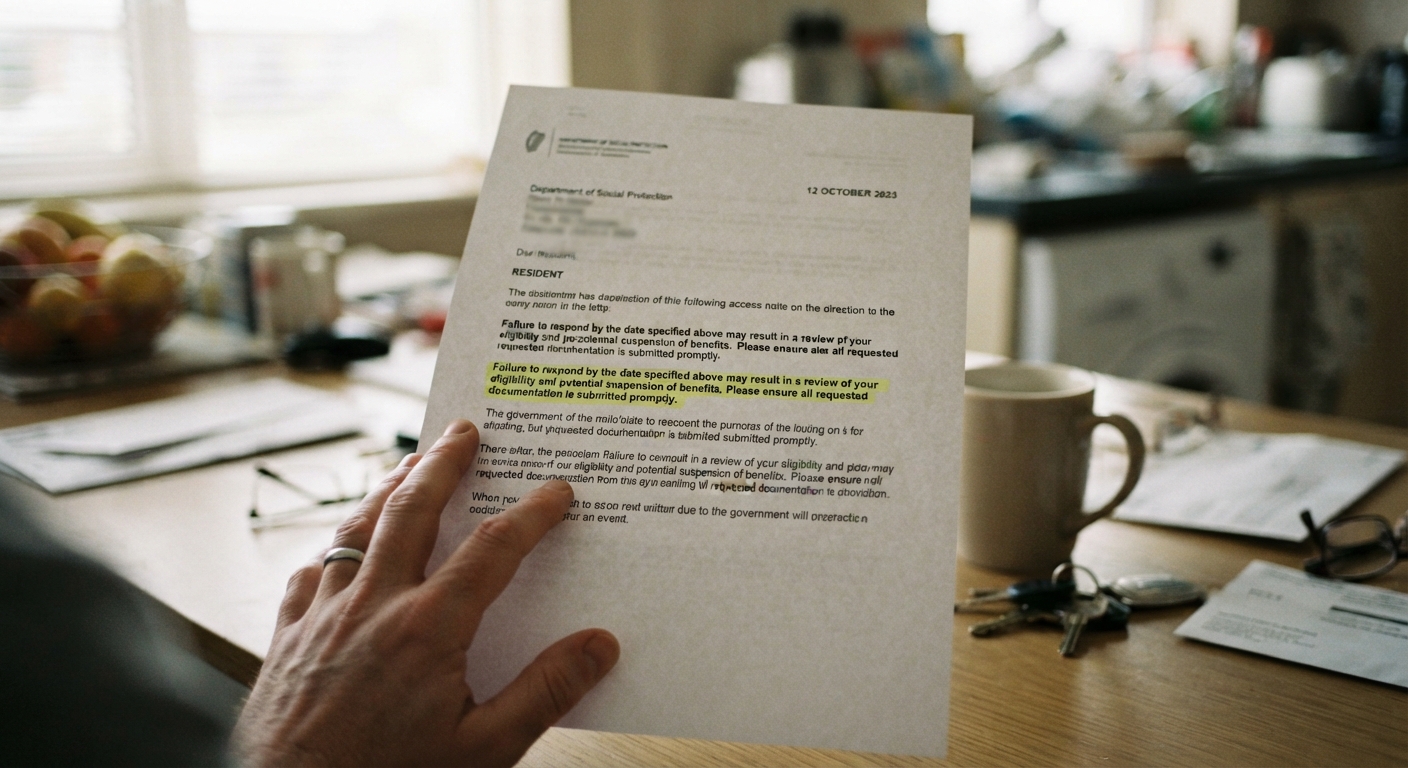
Most denial and termination notices are written backward from how people actually read them. The letter opens with a paragraph of plain-sounding language — “your case has been denied” or “your benefits will end effective [date]” — and it’s tempting to stop there, assume you understand why, and move straight to deciding whether to appeal. But that opening paragraph almost never contains the actual reason. It’s a summary. The real reason, in the form of a code or a short regulatory phrase, is usually printed further down the page, often in a section labeled something like “Reason,” “Basis for Decision,” “Reason for Action,” or a code column next to a table of household members or income figures. Finding it is the first real step in deciding what to do next.
Why the reason code is buried below the main paragraph
Benefits notices are generated by computer systems that were built to satisfy legal notice requirements, not to communicate clearly. The agency is required to tell you what action is being taken, when, and why, and to cite the rule that authorizes it — but nothing requires that information to appear in the first paragraph, or in the order that would make sense to a reader encountering it for the first time. So the letter typically leads with the administrative conclusion (denied, closed, reduced) and saves the mechanism (why) for a data table, a footnote, or a coded field lower on the page.
This layout isn’t unique to one program. Whether you’re holding a SNAP notice, a Medicaid notice, a TANF notice, or a disability decision letter, the structure tends to follow the same logic: conclusion first, reasoning later, citation last. If you only read the top of the page, you’ll know that something happened to your case, but not what triggered it.
To find the reason code, scan the notice for any of the following, usually appearing after the main paragraph:
- A line or box labeled “Reason,” “Reason Code,” “Basis,” or “Explanation”
- A table with columns for household member, program, action, and code
- A short alphanumeric string (letters, numbers, or both) sitting next to a brief phrase like “failure to provide verification” or “income exceeds limit”
- A separate attached page or insert, sometimes titled “Notice of Adverse Action Detail” or similar, stapled or printed after the main letter
If your notice is several pages long, don’t assume the first page has everything. Agencies frequently split the human-readable summary from the coded detail across pages, and the detail page is the one that matters for your response.
Matching the code to the regulation citation
Once you’ve found the code, look for a citation nearby — a short reference to a section of federal or state regulation, sometimes formatted as a string of numbers and letters (for example, something resembling “§ 273.10” or a state administrative code section). This citation is the legal authority the agency is relying on to take the action. It’s not just decoration; it tells you which specific rule the agency believes applies to your situation, which is the thing you’ll need to address if you appeal.
The reason code and the citation are meant to correspond to each other, but the plain-language description sitting next to them is sometimes generic or abbreviated, and it can be hard to tell exactly what the agency thinks happened in your case from the phrase alone. A code that says “failure to provide verification,” for instance, doesn’t tell you which document was missing or when it was due. When the notice doesn’t spell that out, your next move is to look at the rest of the notice for any list of requested documents or deadlines, and to check the denial or closure date against your own records of what you submitted and when.
If the citation is present but you don’t recognize what it covers, a few options can help you interpret it without guessing:
- Search the exact citation string along with the name of your state and the program (for example, the state’s own administrative code database, which is usually searchable online and free).
- Call the number on the notice and ask the caseworker or hotline representative to read you the specific rule language tied to that citation, not just restate the reason in their own words.
- Ask a legal aid or benefits advocacy organization in your area — many maintain plain-language guides to the most common citations for a given program, since the same handful of reasons account for most denials.
Whatever you do, hold onto the exact citation text. If you request a hearing or file an appeal, you’ll want to reference it precisely, and you’ll want to compare it against the actual facts of your case — what you submitted, when, and through what method — rather than against the agency’s summary of those facts.
When the notice lists more than one reason
It’s common for a notice to list two or more reason codes, especially for households with multiple people or multiple programs bundled into one letter (a combined SNAP and Medicaid notice, for example, or a household where one member’s case closed for one reason while another member’s case was reduced for a different one). When that happens, resist the urge to treat the notice as one problem. Each code is a separate finding, and each may have its own citation, its own supporting facts, and potentially its own deadline.
Work through a multi-reason notice methodically:
- List each code and its plain-language description separately, even if they appear on the same line or in the same table row.
- Note which household member and which program each code applies to. A notice covering a family of four may list a different reason for each person, or a different reason for each benefit type.
- Check whether the notice gives one overall response deadline or separate deadlines tied to each reason. If this isn’t clear from the notice itself, this is a good question to ask when you call — get the answer confirmed and, if possible, get the representative’s name and the date of the call.
- Decide whether you’re contesting all of the reasons or only some. You’re generally allowed to appeal one finding without conceding the others, but you should say explicitly in your appeal request which reason or reasons you’re disputing, so the record is clear about what’s actually contested.
Multiple reasons on one notice sometimes reflect genuinely separate issues — say, an unmet reporting requirement for one program and an income change for another — and sometimes reflect one underlying event that the system has coded in more than one place. You don’t need to figure out which it is on your own. Flagging all the codes when you call or write in, and asking the agency to confirm whether they’re related, is a reasonable and expected question.
When the reason code is missing entirely
Occasionally a notice will tell you that your case was denied, closed, or reduced, and simply fail to include a reason code, a citation, or any specific explanation beyond a generic phrase like “based on eligibility rules” or “case review completed.” This happens more often than it should, and it’s worth treating as its own problem rather than trying to guess at the missing reason.
Notices are generally required to state the specific reason for the action and the rule behind it. If that information isn’t on the page you received, you have a right to ask for it, and asking is not the same as appealing — you can request the missing detail while you’re still deciding whether to appeal, and doing so doesn’t use up any of your deadline to request a hearing.
Steps to take if the reason code is missing:
- Call the number printed on the notice itself, not a general agency line, since the notice number often routes to the unit that issued the specific decision.
- Ask specifically for “the reason code and the citation for this decision” — using that phrasing tends to get a more precise answer than asking generally why your case was closed.
- Request that the missing information be sent to you in writing, either as a corrected notice or as a follow-up letter. A verbal explanation over the phone is useful for your own understanding, but a written record protects you if there’s a dispute later about what you were told.
- If the phone line can’t produce a specific code or citation, ask to speak with a supervisor or ask how to request the information in writing through a formal request, sometimes called a request for the case record or case file.
- Write down the date and time of every call, along with the name of whoever you spoke with. If your appeal deadline is approaching and you still don’t have a clear reason, note in your appeal request that you asked for the specific basis for the decision and did not receive it — this becomes part of the record.
A notice without a clear, specific reason is harder to respond to effectively, but it isn’t a dead end. Your right to request a hearing generally doesn’t depend on the agency having done a perfect job explaining itself first. If your deadline is close and the reason still isn’t clear, it’s usually safer to file the appeal or request the hearing on time and continue pushing for the specific reason afterward, rather than letting the deadline pass while you wait for an answer.