
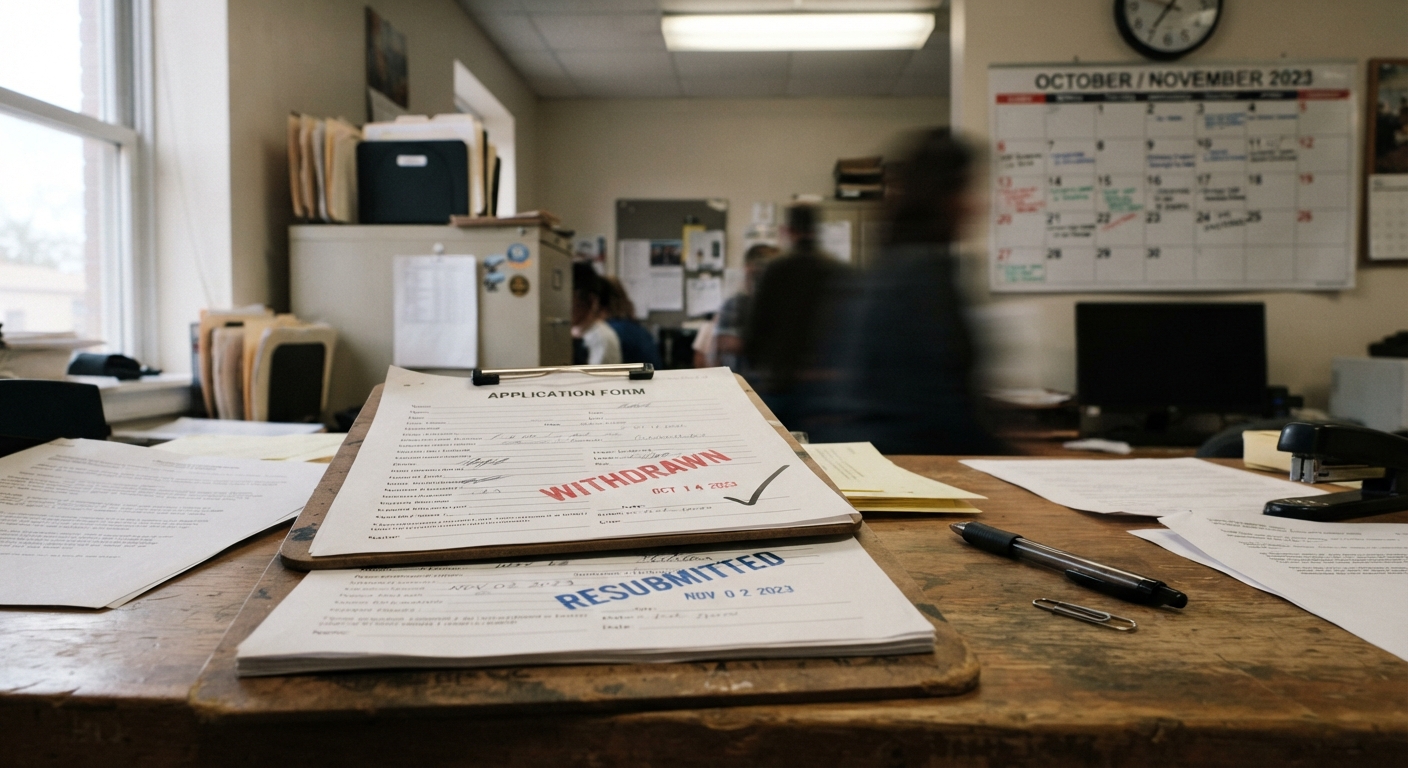
The date stamped on your application is not just a bureaucratic detail. It is the anchor point for everything that follows: how far back your benefits can reach, how long the agency has to process your case, and what happens if something goes wrong along the way. When people run into trouble mid-application — a missing document, a change in household circumstances, a form filled out incorrectly — the instinct is often to start over. That instinct can be expensive if it is acted on the wrong way.
Why the original filing date matters for retroactive benefits and processing deadlines
Most benefit programs calculate potential retroactive payments from the date the agency received your application, not the date it was approved. For SNAP, Medicaid, and many disability programs, this means the weeks or months spent gathering documents, waiting for interviews, or correcting errors are not wasted time from the agency’s perspective — they are folded into your original filing date, and any benefits you are eventually approved for can be paid back to that date.
The filing date also starts the clock on processing deadlines. Agencies are generally required to make a decision within a set number of days of receiving an application. If you withdraw and refile without protecting that date, you may unintentionally reset the clock, giving the agency a fresh deadline and pushing your potential start date for benefits forward by weeks or months.
This is why the mechanics of withdrawing and resubmitting matter so much. Done carelessly, it can cost you retroactive benefits you would otherwise have been entitled to. Done correctly, it lets you fix a genuine problem with your application while keeping the financial protection of your original filing date intact.
Situations where withdrawing and resubmitting makes sense versus simply amending the existing application
Not every problem requires starting over. Most agencies allow you to amend or supplement an application that is still pending — submitting a missing pay stub, correcting a household member’s information, or updating an address does not usually require withdrawal. If your application is still open and active, amending it is almost always the simpler and safer path, because it does not touch the filing date at all.
Withdrawal and resubmission become relevant in a narrower set of circumstances:
Your household situation has changed so substantially that the original application no longer reflects reality — for example, a household member has moved out or a new one has moved in, and the eligibility category itself may be different as a result. Amending piecemeal in this case can create confusion in the case file, and a clean resubmission may better reflect the current situation.
You filed under the wrong program or the wrong category by mistake, and the agency has indicated that continuing to process the original application will not resolve the issue.
You received a request for information that you could not meet in time, and the application was closed for failure to provide verification — in this case you are not withdrawing an active application so much as deciding how to respond to a closure, which is a related but distinct process covered elsewhere on this site.
You have identified errors serious enough — wrong Social Security number, wrong household composition, incorrect program selection — that continuing with the current application risks a denial that could have been avoided by refiling cleanly.
If none of these apply, contact the caseworker or agency and ask specifically whether the issue can be handled through an amendment rather than a withdrawal. Get the answer in writing if possible, or at least note the date, time, and name of the person you spoke with.
The correct procedure for formally withdrawing an application in writing
If withdrawal is genuinely the right move, do it formally and in writing. Do not rely on a phone call alone, and do not simply stop responding to the agency’s requests and assume the application has been withdrawn — an application that is abandoned rather than formally withdrawn may be denied for failure to cooperate, which can complicate any future filing.
A written withdrawal request should include:
Your full name, case number or application number, and the program you applied for.
The date you originally filed the application.
A clear statement that you are withdrawing the application, and the date you are submitting the withdrawal request.
A brief explanation of why you are withdrawing, if you are comfortable providing one — this is not always required, but it can help the caseworker process the request correctly and can support your case later if there is any dispute about what happened.
A statement that you intend to resubmit and, if the program allows it, a request that the original filing date be preserved or protected for the new application.
Submit this letter through a method that gives you proof of delivery: certified mail with return receipt, a fax with a confirmation page, an in-person drop-off with a stamped copy for your records, or an online portal submission that generates a confirmation number or email. Keep every piece of that proof. If you submit in person, ask the person receiving it to stamp or initial your copy with the date.
Before withdrawing, request a copy of the case file or at least a summary of what has been submitted so far, if you do not already have one. This becomes important later when you resubmit and want to avoid duplicating paperwork you have already provided.
How to resubmit while preserving or requesting protection of the original filing date
The resubmission is where most of the risk lives, because agencies are not always consistent about automatically linking a new application to an old filing date. You need to make the connection explicit and put it in writing.
When you submit the new application, attach a cover letter or statement that does the following:
States clearly that this is a resubmission following a formal withdrawal, not a new, unrelated application.
Provides the original application date and the original case or application number, if one was assigned.
Includes the date you submitted the withdrawal request and references the proof of that submission.
Explicitly requests that the agency apply the original filing date for purposes of retroactive benefit calculation and processing deadlines, citing the program’s policy on this if you know it, or simply asking the caseworker to confirm the applicable policy in writing.
Some agencies have a specific form or procedure for this kind of protected resubmission; others handle it informally through caseworker notes. Ask directly: “Will this resubmission be linked to my original filing date, and can you confirm that in writing?” If the answer is no, or if the caseworker is unsure, ask to speak with a supervisor before you finalize the resubmission. It is much easier to resolve this question before the new application is logged than to argue about it after benefits have been calculated from the wrong date.
If the program has a specific window for resubmission — some allow a grace period during which a withdrawn application can be reopened rather than treated as brand new — find out what that window is and stay inside it. Waiting too long between withdrawal and resubmission can itself be treated as abandoning the claim entirely, even if you intended to refile all along.
What documentation to keep proving when the first application was filed
Because so much of this process depends on being able to demonstrate dates and communications later, keep a dedicated file — physical or digital — with the following:
A copy of the original application as submitted, including the date stamp, confirmation number, or receipt from the agency.
Any notices the agency sent you regarding the original application, including requests for additional information, appointment notices, or acknowledgment letters.
A copy of your written withdrawal request, along with proof of delivery — the certified mail receipt, fax confirmation, portal confirmation number, or stamped copy.
Notes from any phone calls related to the withdrawal or resubmission, including the date, the name of the person you spoke with, and a summary of what was said.
A copy of the resubmitted application, including the cover letter referencing the original filing date, and the agency’s acknowledgment of receipt for the new submission.
Any written confirmation from the agency that the original filing date has been preserved or applied.
This file matters most if there is ever a dispute about your retroactive benefit start date or a delay you believe was caused by the resubmission being treated as an entirely new filing. If that happens, you may need to escalate through the agency’s internal review process or a formal appeal, and having a clear, dated record of every step will make that process considerably more straightforward. Keep the file until your case is fully resolved and any retroactive payments have been received and confirmed as correct.